
For the past several years, East Texas has attracted growing attention as a potential new center for domestic lithium production. Recent developments surrounding the Franklin Project now provide perhaps the clearest indication that lithium extraction from the Smackover Formation could become a significant new industry in our region.
On September 8, 2026, Smackover Lithium—the partnership between Standard Lithium and Equinor—announced the results of a Preliminary Economic Assessment (“PEA”) for its Franklin Project in Northeast Texas. The results provide an important first look at the potential scale and economics of commercial lithium production in East Texas.
For Texas mineral and landowners, this is an important development.
The Franklin Project
The Franklin Project is located in Northeast Texas within the Smackover Formation, a subsurface geological formation long known to contain highly mineralized brines.
According to Standard Lithium, the Franklin Project area now encompasses approximately 110,000 acres, with approximately 76,600 gross brine mineral acres already under lease. Brine mineral leasing in the project area has been ongoing since 2022, and the mineral resource underlying the project involves more than 1,100 separate brine and brine-sourced mineral leases.
Exploration and testing have identified unusually high lithium concentrations in the Smackover brines beneath the project. Standard Lithium reports that the Franklin Project contains some of the highest reported lithium-in-brine concentrations in North America.
Those results have now moved beyond exploration data and into preliminary economic modeling.
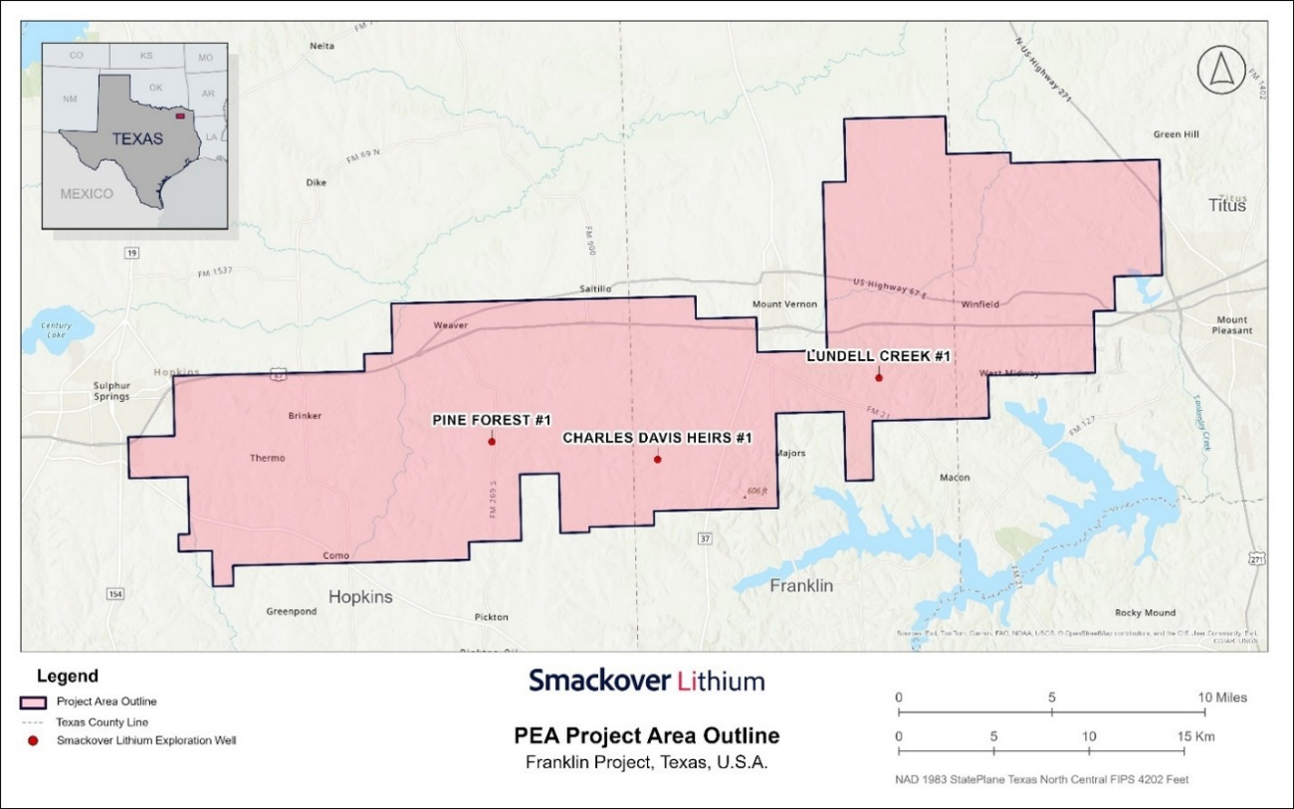
Source: www.standardlithium.com
The Preliminary Economic Assessment Is a Significant Milestone
The recently announced PEA contemplates a lithium operation capable of producing up to 70,000 tonnes of battery-quality lithium carbonate per year, with average production of approximately 64,600 tonnes per year over a modeled 20-year operating life.
The proposed operation would process an average of approximately 455,000 barrels of brine per day.
The projected investment is equally significant. The PEA estimates an initial capital investment of approximately $3.5 billion for the lithium facility and associated wellfield.
Based on the assumptions used in the PEA, the project produced an estimated after-tax net present value of approximately $5.0 billion, an after-tax internal rate of return of approximately 24%, and a modeled payback period of approximately 3.1 years.
These figures remain preliminary. A PEA is not a final investment decision, and mineral resources are not the same as proven mineral reserves. Permitting, engineering, commodity prices, financing, technology, infrastructure, and numerous other factors will ultimately determine whether the project is developed as presently contemplated.
Nevertheless, the assessment represents an important step forward. The conversation surrounding East Texas lithium is increasingly moving from whether a significant resource exists to how that resource might ultimately be developed commercially.
Why East Texas Lithium Matters
Lithium has become an increasingly important component of the modern energy economy because of its use in rechargeable batteries, including electric vehicles and large-scale battery energy storage systems.
Battery storage itself is expanding rapidly. As electric grids incorporate more intermittent generation and electricity demand grows from manufacturing, data centers, and other sources, the ability to store electricity and release it when needed is becoming increasingly important.
That creates an opportunity for Texas.
Texas already has an extraordinary concentration of energy expertise, infrastructure, mineral development experience and private mineral ownership. If commercially successful lithium extraction can be added to that existing energy ecosystem, East Texas could become an important source of domestically produced Lithium for the growing American battery and energy-storage supply chain.
The Franklin Project is particularly noteworthy because it contemplates producing battery-quality lithium carbonate in Texas, rather than simply extracting an unprocessed raw material.
Smackover Lithium has also stated that Franklin is intended to be the first of multiple projects in East Texas, with the partnership targeting more than 100,000 tonnes of annual lithium chemical production in Texas through multiple phases and projects.
In other words, Franklin may not represent the end of East Texas lithium development. It could represent its beginning.
What This Could Mean for East Texas Landowners
The growth of this industry also has important implications for minerals and landowners throughout the Smackover region.
Companies seeking to develop Lithium from subsurface brines must assemble sufficient acreage to drill wells, establish production areas, create units, move and process enormous quantities of brine, and justify the substantial capital investment required for commercial development.
Smackover Lithium has already assembled a large leasehold position in the Franklin Project, and the company has publicly stated that it intends to continue leasing brine-sourced minerals in the area. Additional East Texas projects are also contemplated.
As exploration expands and competing operators evaluate the Smackover, it is reasonable to expect additional East Texas mineral owners to receive offers for brine and lithium leases.
For those landowners, the early stages of this industry may be particularly important.
A Brine Lease Is Not Just Another Oil and Gas Lease
Lithium and brine development is still relatively new in Texas, and the lease forms being presented to landowners can vary considerably.
A brine lease may determine much more than the initial bonus payment. Depending upon its language, it can govern what substances are actually being leased, how royalties are calculated, what costs can be deducted before the landowner receives a royalty, how large a production unit may become, how long acreage can remain tied up, what surface and groundwater rights are granted, what happens if the lease is assigned, and what protections exist if production eventually begins.
Those provisions can have consequences lasting decades.
A seemingly small difference between a royalty calculated on gross proceeds and one calculated after certain costs or deductions, for example, can become significant if a project ultimately produces Lithium at the scale contemplated for Franklin.
Likewise, pooling and unitization provisions deserve careful attention. A landowner's acreage may represent only a small portion of a much larger production unit, making the language governing acreage participation and royalty allocation particularly important.
Surface rights are another significant consideration. Direct Lithium Extraction may have a different surface footprint than conventional mining. However, commercial development can still require production and injection wells, pipelines, processing facilities, roads, electrical infrastructure, and substantial movement of brine.
Landowners should understand exactly what rights they are granting before signing.
This Is the Time for Landowners to Become Educated
The Franklin PEA does not mean that large-scale commercial lithium production will begin in East Texas tomorrow. Standard Lithium currently indicates that initial production could potentially begin in the early 2030s, and substantial development work remains.
That's precisely why this period matters.
Leasehold positions, contractual rights, and development areas are assembled before the processing plants are built and before commercial production begins.
For mineral owners in areas of East Texas underlain by lithium-rich Smackover brines, an unsolicited lease offer may therefore be an early indication that their property is located within an area being evaluated for future development.
Landowners should not assume the first lease form presented represents the only terms available, nor should they focus exclusively on the signing bonus amount.
Understanding the royalty, lease term, extension rights, pooling provisions, surface-use rights, water rights, assignment provisions, indemnification obligations, and acreage-release provisions can be every bit as important as negotiating the upfront payment.
A New Chapter for Texas Energy
Texas has spent generations as one of the world's great oil and natural gas producing regions. The development of lithium-rich brines in the Smackover Formation could add another important resource to that history.
The Franklin Project's Preliminary Economic Assessment is encouraging because it provides something more concrete than speculation. It describes a potential multi-billion-dollar project capable of producing battery-quality lithium carbonate at a globally meaningful scale from beneath East Texas.
Considerable work remains before that vision becomes commercial reality. But the direction of development is becoming increasingly clear.
East Texas has the geology. Companies are assembling the acreage. Exploration wells have confirmed high-quality Lithium brines. Economic studies are now evaluating commercial-scale production. And additional projects are already being contemplated.
For East Texas mineral owners, now is the time to understand this emerging industry.
The leases being negotiated today may determine who participates in the economic benefits of Texas lithium development for decades to come.
If you have been offered a brine lease for lithium extraction, it is important to contact an attorney who can help you navigate this new energy frontier.
Robert “Bobby” T.C. Sanders
Texas Lithium Lawyer
BrineLease.com
This article is provided for general informational purposes only and is not intended as legal advice. The terms and legal consequences of any brine or lithium lease depend upon the particular facts, ownership interests, and language of the agreement.